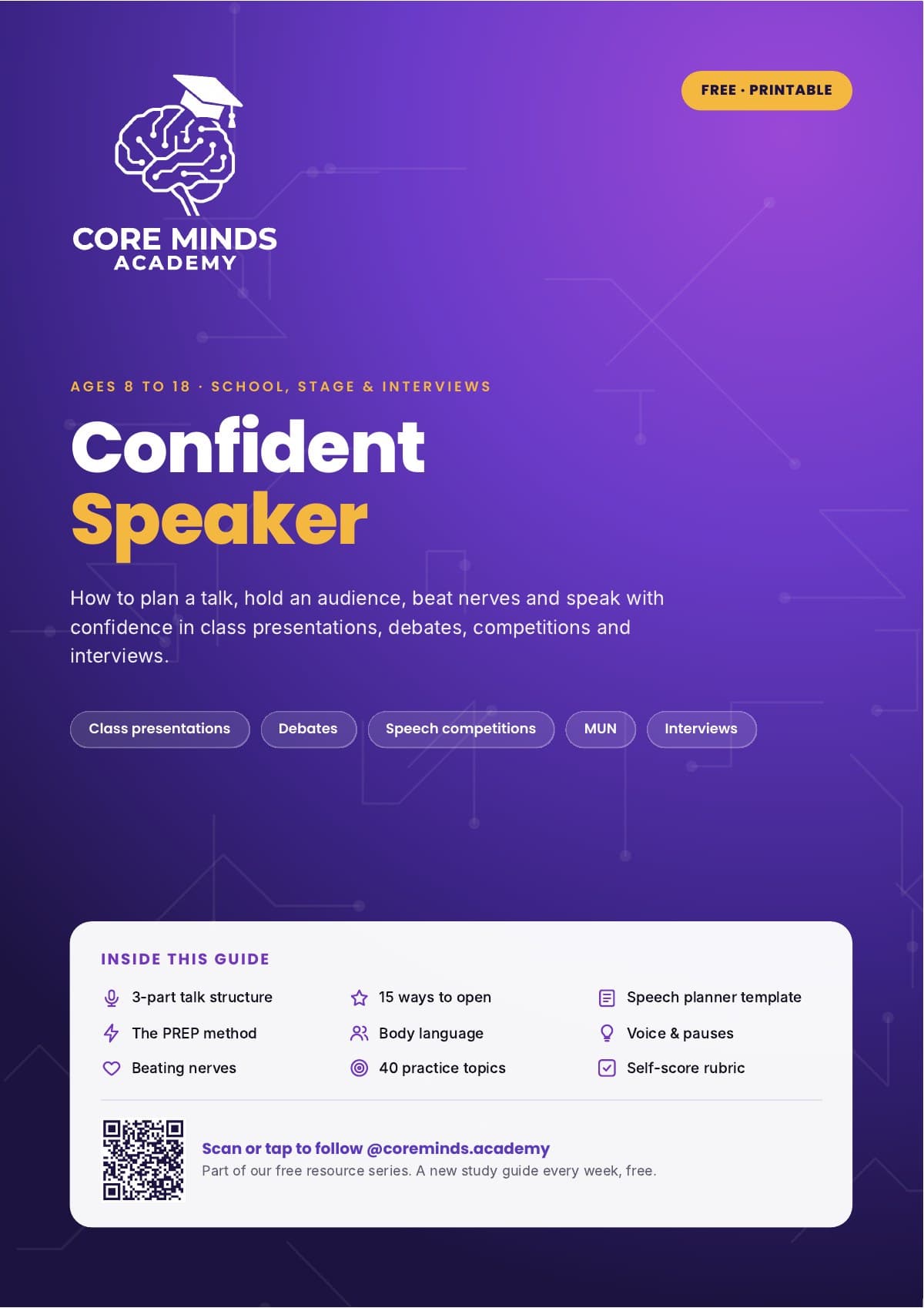
Finding good speech topics for kids is often harder than writing the speech itself. This guide gives you 60 ready-to-use ideas sorted by grade and by type, a simple 2-minute structure, one sample speech written out in full, and a home practice routine you can start tonight.
How to choose a speech topic by grade
The best topic is one your child already has something to say about. A child who loves cricket will speak better about cricket than about a topic that only sounds impressive. Let them shortlist three ideas, talk about each for thirty seconds, and pick the one where the words came most easily.
Use this table to match the length and type of speech to your child's grade.
| Grade band | Speech length | Type that suits best |
|---|---|---|
| Grades 1 to 3 | About 1 minute | About me and fun topics, told like a small story |
| Grades 4 to 6 | 1 to 2 minutes | Informative topics and simple persuasive topics with three reasons |
| Grades 7 to 9 | 2 minutes | Persuasive topics with examples, and informative topics that explain how something works |
| Grades 10 to 12 | 2 to 3 minutes | Persuasive and reflective topics with a clear personal opinion |
As a rough guide, a calm 2-minute speech fits on one handwritten page. If the draft runs to two pages, cut it.
Speech topics for kids in grades 1 to 3
Keep these short and personal. One idea, two or three details, and a happy ending line is enough.
About me
- My favourite toy and why I love it
- The best day I ever had
- What I want to be when I grow up
- My family and what makes us special
Persuasive
- Why every child should have a pet
- Why we should have a longer lunch break
- Why everyone should hear a bedtime story
- Why each of us should plant one tree
Informative
- How a seed becomes a plant
- Why we brush our teeth twice a day
- My favourite animal and where it lives
- How to cross the road safely
Fun
- If I could talk to animals for one day
- If I had a magic school bag
- The funniest thing that ever happened to me
Speech topics for grades 4 to 6
Children at this stage can give reasons and explain steps. Ask them to find three points before they write a single sentence.
About me
- A hobby I could teach you in two minutes
- The person I admire most in my family
- A mistake that taught me something
- My favourite festival and how we celebrate it
Persuasive
- Why homework should be shorter but smarter
- Why every school needs a kitchen garden
- Why every child should learn to cook
- Why reading a book beats watching a video
Informative
- How the water cycle works
- How to save part of your pocket money
- Why the moon seems to change shape
- What happens to our rubbish after it leaves home
Fun
- If I were the principal for a day
- The invention I wish existed
- What my pet is really thinking
Speech topics for grades 7 to 9
Middle schoolers are ready to take a side and defend it. Push for one real example in every point, from school, home or the news.
About me
- A book that changed how I think
- What I learned from losing a competition
- A skill I taught myself
- The place where I feel most at home
Persuasive
- Why schools should teach money skills
- Why phones should stay out of the bedroom at night
- Why every student should try coding
- Why failing at something can be the best lesson
Informative
- How a search engine finds an answer
- What causes an earthquake
- How the heart moves blood around the body
- How to check if a news story is true
Fun
- If I could have dinner with anyone from history
- Three rules I would add to my school
- A day in my life with no internet
Speech topics for grades 10 to 12
Older students score well when they sound like themselves. A clear opinion, honestly argued, beats a speech full of big words.
About me
- A decision that shaped who I am
- What I want from my future career
- A belief I have changed my mind about
- What leadership means to me
Persuasive
- Why marks do not measure intelligence
- Why every teenager should do volunteer work
- Why social media needs a daily time limit
- Why financial literacy belongs in every classroom
Informative
- How artificial intelligence learns from examples
- How compound interest makes savings grow
- What climate change could mean for my city
- How to prepare for a college or job interview
Fun
- A letter to my ten-year-old self
- If I could redesign school from scratch
- The most useless superpower and how I would use it
A simple 2-minute speech structure, with a sample
Almost every good short speech follows the same three-part shape. Teach it once and your child can reuse it for any topic.
- Opening (about 15 seconds). Greet the audience, then start with a question, a surprising line or a tiny story. Say the topic clearly.
- Three points (about 30 seconds each). One sentence that states the point, then one or two sentences with an example. Use the signpost words first, second and finally.
- Close (about 15 seconds). Repeat the main idea in fresh words, ask the audience to do or remember one thing, and say thank you.
Here is a full sample for grades 4 to 6 on the topic Why every child should learn to cook.
Good morning, teachers and friends. Have you ever been hungry at home and waited, and waited, for someone to make you a snack? Today I want to tell you why every child should learn to cook.
First, cooking makes us independent. Last month I learned to make a sandwich on my own. Now, when I come home from school, I do not have to wait for anyone.
Second, cooking teaches us math and science without a textbook. When I help my mother make a cake, I measure half a cup of milk and watch the batter rise. That is fractions and science in one bowl.
Finally, cooking helps us respect food and the people who make it. After spending an hour making dinner with my father, I never leave food on my plate.
So, friends, cooking makes us independent, smarter and more thankful. This weekend, ask an adult at home to teach you one simple dish. You may enjoy it more than you expect. Thank you.
Delivery tips that make any speech better
- Slow down. Nervous speakers rush. Ask your child to pause and breathe at every full stop.
- Look up. Pick three friendly faces, one on the left, one in the middle and one on the right, and speak to each in turn.
- Stand still. Feet apart, hands relaxed at the sides or holding one small cue card. No swaying.
- Use cue cards, not a script. Write only the opening line, three key words and the closing line.
- Speak to the back row. A voice that reaches the last bench sounds confident even when the speaker is not.
- Keep going after a slip. The audience does not know the script. Smile, breathe and move to the next point.
How to practise a speech at home
Ten minutes a day for five days works better than one long session the night before. Try this routine.
- Day 1: Read the speech aloud twice, sitting down, and mark the hard words.
- Day 2: Stand up and read it with pauses. Time it with a phone.
- Day 3: Move to cue cards. Expect stumbles, they are part of learning.
- Day 4: Record a video. Let your child watch it and name one thing they liked and one thing to fix.
- Day 5: Give the speech to a small home audience, such as grandparents on a video call.
When you give feedback, praise one specific thing first, then suggest only one change. A long list of corrections makes children freeze.
If your child wants regular speaking practice with a teacher, Core Minds Academy runs live 1:1 and pairs English speaking classes that include speeches, storytelling and conversation. You can book a free trial class to see how your child responds, or browse more ideas on our blog.